

read more
Substance Use and Lung Transplant: Facts, Honesty, and Healing
Alongside the extraordinary circumstances of living with a lung transplant, recipients experience many of the same joys and struggles as …
Wherever you are in your lung transplant journey, you’re facing a path that can often feel stressful and at times overwhelming. But while many of the resources for lung transplant patients and caregivers focus on providing necessary medical support, too often the mental and emotional toll of the experience is overlooked. Resources such as the Lung Transplant Foundation’s Mentorship program, as well as community support groups, and mental health professionals are vital to the wellbeing of those in our community. However, researchers suggest there may be another way you can sort through emotionally challenging experiences. It is entirely free and requires nothing more than a pen and a piece of paper: writing.
Since the late 21st century, expressive writing, or journaling, has been a focus of significant research in both psychology and medicine. Doctors at the University of Rochester Medical Center suggest that regular writing can help individuals manage anxiety, reduce stress, cope with depression, help individuals engage in “positive self-talk,” and “identify negative thoughts.” While this is true for individuals across the board, the American Psychological Association offers that “expressive writing may also offer physical benefits to people battling terminal or life-threatening diseases” with researchers believing that alleviating stress through writing can, for some patients, “boost immune functioning.” While experts continue to debate the long-term physical effects of writing, there is reason to believe that at the very least, the mental and emotional impact of writing can be truly profound for anyone living through significant life changes.
Though it’s not entirely clear why writing can be so beneficial, psychologist James Pennebaker, one of the grounding researchers and supporters of the therapeutic benefits of writing, suggests that similar to talk therapy, writing can allow individuals to express deep emotions, fears, and perhaps most importantly, learn to make meaning of their life experiences.
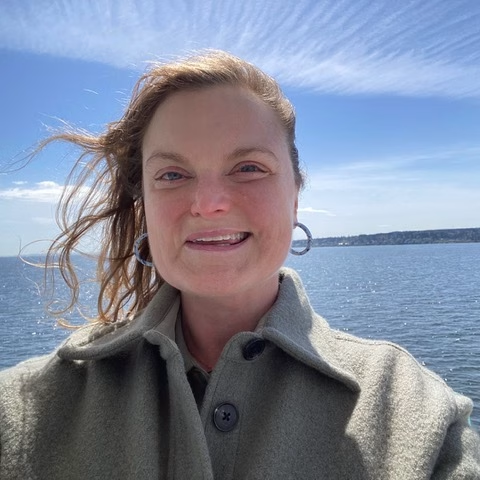
“Writing made me a co-author in lung transplant and in my life in general.” —Rosa Singer, double lung transplant recipient
Many individuals keep diaries as children or young adults, cataloging the daily events of their young lives, only to give it up once they reach adulthood. But expressive writing, or journaling, may differ from how we often think of this practice. While it may include documenting day-to-day life events, the primary purpose of expressive writing is to release and process emotional experiences.
Though already a lifelong advocate of journaling, in 2019 when Rosa Singer received a double-lung transplant after her terminal diagnosis of progressive lung fibrosis, it became an integral part of her daily routine. While spending two-and-a-half years on the transplant waitlist, she began relying on journaling as a regular “practice and refuge.”
“There was so much I needed to say considering my terminal diagnosis,” Rosa explained. “The sorrow, the loss, the worry. The hope, the beauty, the daily moments with loved ones. The medical experiences. The birds outside my window. Journaling was a place for all of it. It helped me gain perspective to keep going.”
Though Rosa was no stranger to the power of writing, it was not until her medical diagnosis and pursuit of lung transplant that it took on an even deeper meaning in her life.
“At times, it’s been a rope I hold onto to help me cross a turbulent river. Other times, it’s been an instrument to capture awe or gratitude,” she explained. “I love that writing can be anything I want it to be as an expressive art form. Writing made me a co-author in lung transplant and in my life in general. It’s given me a sense of personal agency, and that is important because transplant is full of things that are out of our control.”
“ It was almost as if I was writing myself into continued existence.”
The personal empowerment Rosa has gained from daily writing is not uncommon. Though not chiefly focused on individuals struggling with chronic medical conditions or terminal illness, mental health and trauma researchers have found that writing, and storytelling, can help us find language for all kinds of difficult life circumstances, from the mundane to the extreme. This act alone can help individuals feel more empowered to speak up, connect with their community, or even share their story beyond the pages of their personal journal.
For Rosa, her approach to, and even style of writing evolved alongside the progress of her lung transplant, with her writing morphing from daily journal entries into poetry, and eventually short personal essays.
“I’d be in the garden, looking under a tomato vine, when the start of a poem would come to me, like it had been whispered into my ear,” she explained. Following this inspiration, she signed up for poetry classes, and began pouring herself into this new artistic expression, eventually participating in literary events and poetry readings to share her work..
“I felt a lot of urgency to keep writing, keep expressing, keep allowing,” she said. “I think I did this, in part to document that I was still alive…much of my poetry at that time was declarative and affirming to my life. It was almost as if I was writing myself into continued existence.”
For Rachel Miranda, 59, developing a writing practice provided her a sense of daily purpose, both pre and post lung transplant. After being diagnosed in 2021 with interstitial lung disease, by April 2024 Rachel was on full-time oxygen, and in March 2025 received a single-lung transplant.
“Once I began to fully realize that I was headed for transplant, or the end of my life, I started making copious notes for a blog or newsletter about this experience,” she explained. Though she resisted sharing her writing until after her transplant, in August 2025 she launched her series, Air Hunger on Substack, where she has been posting about living with a lung transplant bi-weekly ever since.
“This has been a particularly powerful and challenging task for me, as it’s pushing me to articulate all of the different complex, conflicting, controversial, surprising, frustrating, confusing, and even joyful emotions that have arisen for me through this process… I have to confess, too, that these posts might eventually become the building blocks of a memoir.”
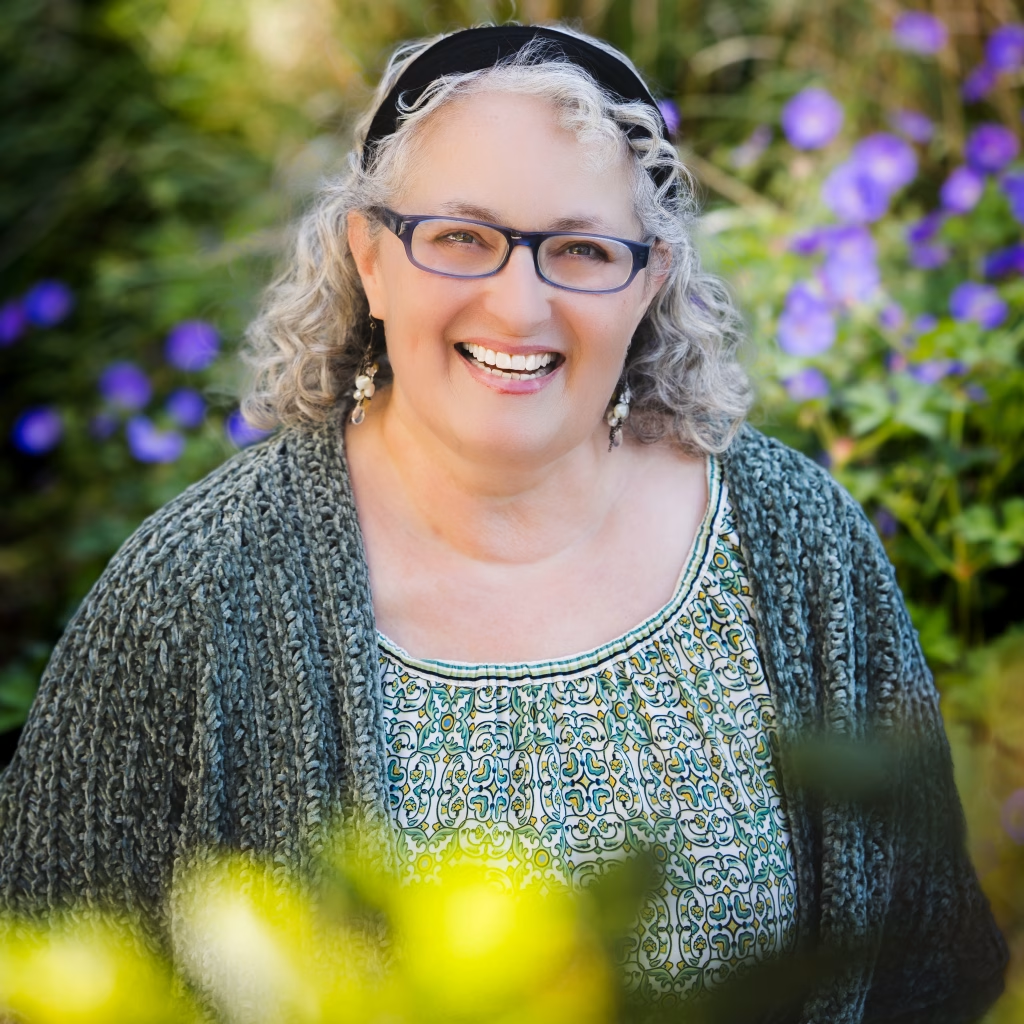
“[Writing] helps me to make sense of this most challenging year of my life.” —Rachel Miranda, single lung transplant recipient
Though she loved to write as a child, Rachel reconnected with her love of writing before her transplant, releasing a cookbook in 2021: The World at Our Table: A Euro-American Cookbook of Family Favorites. She also spent the decade prior to her transplant drafting and revising her debut novel Broken Chocolate (due out March 2026 with Vine Leaves Press), which she says has been a “powerful motivator through this crazy year,” helping her to “keep on looking forward even when things are really tough.”
Still, like Rosa, it is the writing she has done about her transplant that has been some of the most meaningful for her.
“First, it’s something enduring I can leave behind if things go off the rails for me – a possibility I’m living with every day,” she reasoned… “Second, it helps me to make sense of this most challenging year of my life. I often feel some sense of clarity or resolution after I’ve written a piece for Air Hunger. And third, I’m all too aware of how little is known culturally about lung disease and transplants – we are a tiny percentage of the population and there’s not a great deal of writing out there for people who want to understand this journey a little better, or who are on it themselves and want to feel seen, to feel less alone.”
Though writing through the challenging experience of lung transplant can be beneficial even if it remains entirely private, the Center for Trauma and Embodiment suggests that storytelling with the intention of sharing can also lead to positive changes in an individual’s mental health. “When survivors share their stories with others, they often receive understanding, compassion, and support, which can significantly reduce feelings of isolation and shame.”
Still, starting from a place of private, personal reflection can be deeply beneficial. When asked why they believe this kind of writing can be so impactful on mental health, both Rosa and Rachel had a lot to say, especially in terms of how writing can positively impact the lives of lung transplant recipients.
“Our brain and body want to know we are safe. That’s especially true for transplant folks.”
“Writing has helped me claim my voice, my creative imagination, my joys and struggles – both in medical settings and in daily life,” Rosa explained. Rachel offered a similar perspective, offering that “being able to continue writing even when my body is malfunctioning has changed the nature of my recovery.”
For Rosa, the power of writing is in not only the expression of deep emotions and experiences, but in the feelings that come after.
“Our brain and body want to know we are safe. That’s especially true for transplant folks,” she said. “Expressive writing helps us discover what is on the inside and/or what we observe around us, giving it structure, and making meaning through words and storytelling. I’ve found that expressive writing can lead to a sense of release as well as the positive feelings of agency and voice. Writing as a creative action means I’m ‘doing something’ that is generative and supportive, and personally it makes me feel seen and heard, even within myself.”
Despite publicly documenting her lung transplant journey, Rachel explains how writing allows us space to make sense of our internal thoughts, without needing to share them with anyone else.
“Writing has the power to lift us up because it allows us to take the thoughts out of our heads where they are spinning around and around like socks in a dryer and put them in front of our eyes where it’s somewhat easier to make sense of them,” she explained.. “To give us some grace about what we are feeling until we find some clarity. Yet, it’s not performative unless we choose to share it with others.”
Doctors at the University of Wisconsin Madison’s Integrative Health Program promote the practice of “therapeutic journaling” as a means of forming “a meaningful personal narrative” about your life. They suggest writing for 15-20 minute sessions every day, for at least four consecutive days. Though therapeutic journaling in a clinical setting often focuses on intentionally exploring difficult life experiences, or feelings, some psychologists suggest that focusing too much on negative emotions can have an adverse effect if not accompanied by personal reflection, and that “to tap writing’s healing power, people must use it to better understand and learn from their emotions” rather than simply venting them. Therefore, when writing at home, in your free time, it can be helpful to vary the styles and approaches to your writing.
Rather than leaning on a prescriptive approach, Rosa and Rachel recommend doing whatever feels both beneficial and sustainable for you.
“I have found the best way to start is to jot down little snippets of impressions, memories, experiences, sensations, interactions that stick with me… even lists of subjects I am thinking about. Sometimes those turn into whole paragraphs or pages,” Rachel said.
For Rosa, journaling – especially gratitude journaling – is a great place to start. “Write down one to two things each day you’re grateful for and reflect on why.” She also recommended not limiting yourself to only journaling, but to follow your creativity wherever it takes you. “If you feel compelled to write stories about your experiences, you can mine journaling for the impactful moments you want to explore further. Start by noticing any emerging themes… once you’ve selected the theme, do a 10-minute free writing without stopping.”
Both Rachel and Rosa have active plans for their writing this year. As Rachel continues to write about her lung transplant journey in her bi-weekly series Air Hunger, and promote her forthcoming debut novel, Rosa is developing a micro-essay and poetry manuscript she hopes to submit for publication by the end of this year.
Rosa is also collaborating with the Lung Transplant Foundation to offer writing workshops later this year. For more information, please contact LTF’s Educational and Program Coordinator Lena Ziegler at lena@lungtransplantfoundation.org.
At the Lung Transplant Foundation, it is our goal to provide holistic support for those going through a lung transplant journey, both from the patient and caregiver perspective. Whether you are an experienced writer looking to process your emotional experience of lung transplant, or gain practice telling your own story, we are here to support you!
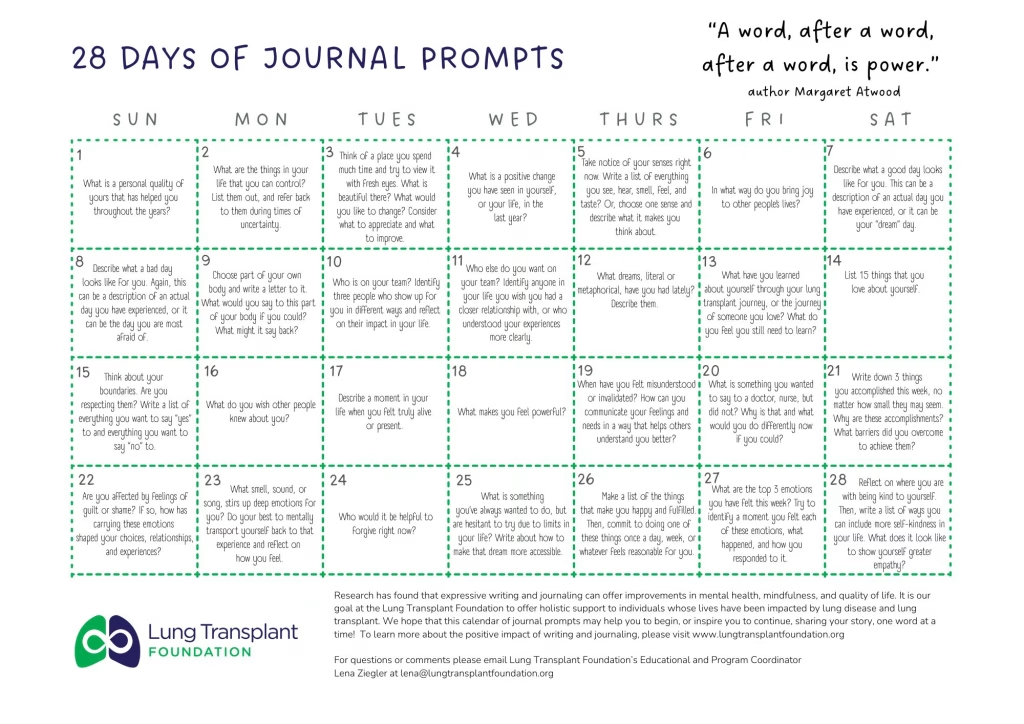
That’s why to help you get started with your own writing practice, for the month of February we are providing daily prompts for journaling and reflection. Each prompt is listed in detail below, however an abridged printable version is also available for your convenience! You may follow along daily, or pick and choose from the available prompts and simply write when the moment strikes you. We hope no matter what approach you take to developing a writing practice, you consider incorporating regular writing into your self-care routine.
Day 1 – What is a personal quality of yours that has helped you throughout the years?
Day 2 – What are the things in your life that you can control? List them out, and refer back to them during times of uncertainty.
Day 3 – Think of a place you spend much time and try to view it with fresh eyes. What is beautiful there? What would you like to change? Consider what to appreciate and what to improve.
Day 4 – What is a positive change you have seen in yourself, or your life, in the last year? Why does that matter to you?
Day 5 – Take notice of your senses right now. Write a list of everything you see, hear, smell, feel, and taste? Or, choose one sense and describe what it makes you think about.
Day 6 – In what way do you bring joy to other people’s lives?
Day 7 – Describe what a good day looks like for you. This can be a description of an actual day you have experienced, or it can be your “dream” day.
Day 8 – Describe what a bad day looks like for you. Again, this can be a description of an actual day you have experienced, or it can be the day you are most afraid of. What might bring you care and comfort on a day like that?
Day 9 – Choose part of your own body and write a letter to it. What would you say to this part of your body if you could? What might it say back?
Day 10 – Who is on your team? Identify three people who show up for you in different ways and reflect on their impact in your life.
Day 11 – Who else do you want on your team? Identify anyone in your life you wish you had a closer relationship with, or who understood your experiences more clearly.
Day 12 – What dreams, literal or metaphorical, have you had lately? Describe them.
Day 13 – What have you learned about yourself through your lung transplant journey, or the journey of someone you love? What do you feel you are still learning?
Day 14 – List 15 things that you love about yourself. Fun fact! In addition to Valentine’s Day, Feb. 14 is National Donor Day
Day 15 – Think about your boundaries. Are you respecting them? Write a list of everything you want to say “yes” to and everything you want to say “no” to.
Day 16 – What do you wish other people knew about you?
Day 17 – Describe a moment in your life when you felt truly alive or present. Where were you? What was around you? Were you alone or with others?
Day 18 – What makes you feel powerful? It can be anything – a color, a song, a relationship, an activity, etc.
Day 19 – When have you felt misunderstood or invalidated? How can you communicate your feelings and needs in a way that helps others understand you better?
Day 20 – What is something you wanted to say to a doctor, nurse, but did not? Why is that and what would you do differently now if you could?
Day 21 – Write down 3 things you accomplished this week, no matter how small they may seem. Why are these accomplishments? What barriers did you overcome to achieve them?
Day 22 – Are you affected by feelings of guilt or shame? If so, how has carrying these emotions shaped your choices, relationships, and experiences? What might happen if you found a way to release these feelings?
Day 23 – What smell, sound, or song, stirs up deep emotions for you? Do your best to mentally transport yourself back to that experience and reflect on how you feel.
Day 24 – Who would it be helpful to forgive right now? Is it someone currently in your life? No longer in your life? Yourself?
Day 25 – What is something you’ve always wanted to do, but are hesitant to try due to limits in your life? Write about how to make that dream more accessible.
Day 26 – Make a list of the things that make you happy and fulfilled. Then, commit to doing one of these things once a day, week, or whatever feels reasonable for you.
Day 27 – What are the top 3 emotions you have felt this week? Try to identify a moment you felt each of these emotions, what happened, and how you responded to it.
Day 28 – Reflect on where you are with being kind to yourself. Then, write a list of ways you can include more self-kindness in your life. What does it look like to show yourself greater empathy?
Many thanks to Rosa Singer and Rachel Miranda for their editorial feedback on this calendar of prompts.
If you are interested in future writing programming or sharing your own story, please contact lena@lungtransplantfoundation.org.
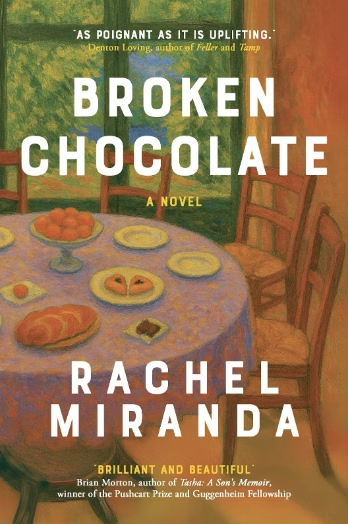
Rachel Miranda is a writer and author. Her substack series Air Hunger documents her lung transplant journey. Her debut novel Broken Chocolate will be published March 2026 with Vine Leaves Press. To learn more about her cookbook The World at Our Table and her other creative writing, please visit https://www.rachelmiranda.com/.
Rosa Singer is a poet and writer. She was recently a featured reader for the monthly Hugo House salon (Seattle’s Center for Literary Arts) in June and October of 2025. In September 2025 Rosa was a guest speaker and reader, alongside best-selling author Emily Rapp Black, for the Lung Transplant Foundation’s Transplant Talk “Writing Your Story: Finding Narrative Wisdom in Your Body.”
Alongside the extraordinary circumstances of living with a lung transplant, recipients experience many of the same joys and struggles as …

Receiving a lung transplant is a transformative, life-saving event. For individuals who faced late-stage lung disease, a successful transplant offers …

What Patients and Families Need to Know A lung transplant is a life-saving procedure for individuals living with late-stage lung …

Creating a world where all lung transplant patients live long, healthy lives.
1249 Kildaire Farm Road, Suite 323
Cary, NC 27511
Disclaimer: This website does not provide medical advice. The information, including but not limited to text, graphics, images, and other material contained on this website are for informational purposes only. No material on this site is intended to be a substitute for professional medical advice, diagnosis, or treatment. Always seek the advice of your physician or other qualified health care provider with any questions you may have regarding a medical condition or treatment before undertaking any new health care regimen. Never disregard any professional medical advice or delay in seeking care because of something you have read on this website.