
read more
Substance Use and Lung Transplant: Facts, Honesty, and Healing
Alongside the extraordinary circumstances of living with a lung transplant, recipients experience many of the same joys and struggles as …
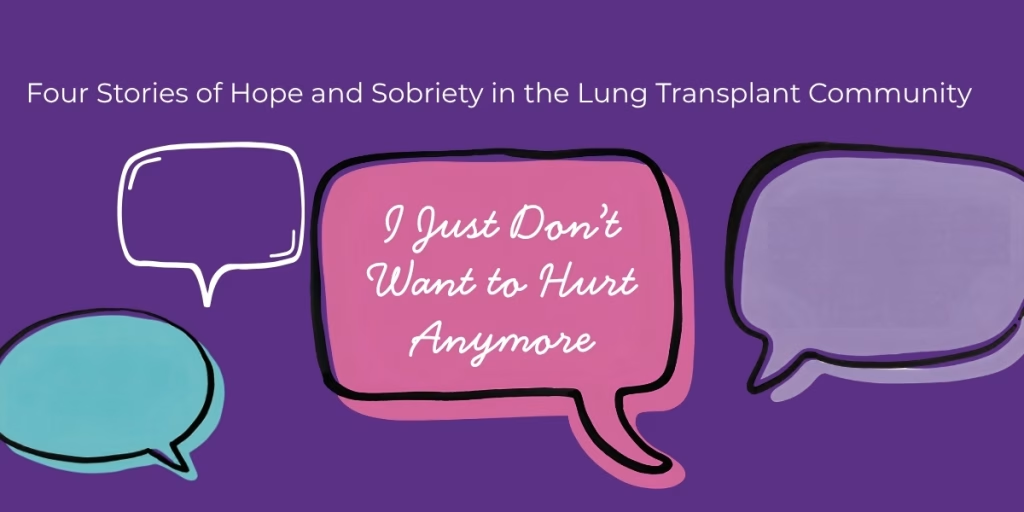
Lung transplant and substance abuse are rarely used in the same sentence. Yet, it is not uncommon for an individual’s transplant journey to overlap, in some way, with a journey toward recovery from substance abuse. That’s why in support of National Recovery Month, we sat down with four individuals at various stages of their lung transplant journey, as well as their ongoing recovery from addiction, and learned about their experience navigating both life-altering challenges simultaneously:

Bob, whose relationship with alcohol took a toll on his body post-transplant, and who has since found sobriety as he celebrates his 1 year lung-a-versery this September;

Cora, whose pediatric medical diagnosis and post-transplant medical trauma led directly to substance abuse, and an active journey toward recovery;

Doug, who after celebrating over 25 years of sobriety finds strength in his recovery journey while managing lung disease and awaiting lung transplant; and

Carrie, who chose sobriety in an effort to be approved for lung transplant, and now celebrates 25 years in recovery, and 22 years post-transplant.
Each of their stories provides unique insight into the complicated issue of substance abuse and how it can intersect physically and emotionally with lung transplant. As you read their stories, we wish to remind you that this article does not provide any medical advice. The information included is for informational purposes only and is not intended to be a substitute for professional medical advice, diagnosis, or treatment. Always seek the advice of your physician or other qualified healthcare provider with any questions you may have regarding a medical condition, or treatment, before undertaking a new health regimen. For information specifically addressing recovery and substance abuse disorder, visit www.samhsa.gov.
Please note, out of respect for the sensitivity and vulnerability of this topic, some names and personal details may have been altered to provide anonymity to the individuals who have graciously chosen to share their story.
For years, Bob thought he had established a manageable relationship with substances. It wasn’t until discovering he would need a life-saving lung transplant, that his reliance on alcohol became a life-threatening problem.
While avoiding alcohol is a known requirement for lung transplant, Bob’s commitment to sobriety did not begin the day he was listed. In fact, despite an up-and-down relationship with alcohol throughout his life, Bob described himself as feeling comfortable and in control of his alcohol use for years prior to being listed. He had, however, struggled with alcohol abuse in the past.
“In my mid-20s to mid-30s, I went through a divorce with my first wife and I drank heavily. I did. I drank heavily,” he admits. “But then after that, I quit. For about 5 years, I just completely quit.”
Taking a “cold turkey” approach, Bob said after this difficult period, drinking became a purely social activity. Even after the stress of being diagnosed with COPD 15 years ago, he never returned to abusing alcohol, explaining that, “it got to a point that I could take it or leave it.”
Despite years of a controlled relationship with alcohol, once Bob was listed for transplant the intense fear and stress of needing one and waiting for the call led to him relying on alcohol more, and more, as a means of coping. While much of his drinking remained social with friends on the weekend, he began regularly drinking two or three beers a day, sometimes more.
“It was a lot of stress. And that was my stress relief,” he explains. “I went through something that I wouldn’t wish on my worst enemy, you know? It was a life changing event that I went through…I was so nervous every time the phone rang after I got listed. And I got to the point of, well, it’s not going to happen today, so I’ll have a few beers…You think you’re easing the stress. And the day it did happen, and she called and said ‘we have lungs,’ it was like ‘boom.’ Like a bomb dropping…I should have said something but I didn’t. So I went through the transplant and that’s where all the trouble began.”
Though Bob drank the day before receiving his call for transplant, September 3, 2025, he did not disclose this to his medical team for fear that he would be rejected for transplant and they would not go through with the surgery. So when Bob began to experience medical complications, both during the surgery and after, his transplant team could not determine the cause.
“They knew something was wrong. They just didn’t know what exactly it was,” he explains.
“My wife walks into the hospital and she hears ‘code blue’ with my room number.“
While the surgery ultimately progressed and went fine, the bulk of his medical issues came during post-transplant recovery.
“I spent 23 days in the hospital, where I should have spent maybe 10. People are in the hospital longer than that, but in my circumstances, I should have been out of there much quicker. I don’t even remember the first two weeks after my surgery.”
While many lung transplant recipients experience what is sometimes referred to as “ICU delirium,” Bob said his experience with terrifying nightmares and hallucinations was so intense, they are all that he can recall from his initial recovery period.
“They haunt me today,” he says. “I will go to bed and, I’m not afraid to admit it, it scares the heck out of me. Because it comes back to me. It was so real. And through this, they couldn’t figure out what was going on. They didn’t know I was drinking and, of course, I didn’t tell them.”
Bob’s post-surgical complications reached a breaking point when seven days after his transplant, he nearly lost his life.
“My wife walks into the hospital and she hears ‘code blue’ with my room number,” he says. “She walks in and they’re flipping me over and have the paddles on my back, because I couldn’t do the paddles on my chest because of the transplant. And they brought me back. And my doctors didn’t understand. Until they figured it out.”
Despite his fear of admitting to alcohol use while waiting for transplant, Bob says that he has since come to understand that if he had been honest up front, preventative measures could have been taken and many of his complications may have been avoided.
“The delirium was multiplied. The health part was multiplied. It was rough. It was rough on my family. And the bottom line was, I wasn’t honest with everyone and I wasn’t honest with myself.”

“I wasn’t honest with everyone and I wasn’t honest with myself.”
—Bob, 58
After returning home, Bob committed fully to his post-transplant recovery, and has no intention of drinking again in the future. He has even found new and healthier coping mechanisms for managing the often intense stress of post-transplant life including talking more openly with his wife, and committing to daily exercise.
“I’m walking like 8 miles a day. And then I ride my stationary bike for, like, an hour a day,” he explains proudly. He clarifies that, with the support of his doctor, he breaks up this activity throughout the day so as to not push himself too hard.
“There were those times I just broke down and cried. I was scared. This is a scary thing. It still is scary.”
“It helps not only physically getting myself back, but stress. It’s a stress relief,” he says. “If I was still drinking, I wouldn’t exercise. If I came back from the transplant and picked up a beer, I wouldn’t exercise. Not at all. And it would probably kill me.”
As he celebrates his one-year lung-a-versery this September, life post-transplant is difficult, and still scary. But for Bob, the miracle of his transplant, the life-saving efforts from his own transplant team, and his intense gratitude to his donor has taken away his desire to drink. However, as a member of several online forums, and Facebook groups, dedicated to lung transplant, the topic of substance use comes up frequently, reminding him of the ongoing struggle this can be for so many individuals. So in addition to encouraging transplant centers and doctors to be more consistent with messaging about alcohol and substance use, as well as his suggestion to increase testing to rule out alcohol abuse a patient may be hiding, Bob also wants to encourage anyone facing transplant to lean on their support system, rather than relying on substances.
“Whether it’s your wife, whether it’s your best friend, or a professional, talk to somebody,” he says. “I was scared to death. There were those times I just broke down and cried. I was scared. This is a scary thing. It still is scary. So reach out. And if you’re going through the evaluation, each patient is assigned a social worker. Lean on your support. It’s amazing what you can do just by talking, just to get things out.”
Throughout her life, Cora has only ever been “the sick person.” Diagnosed with pulmonary arterial hypertension at just 15 years old, both her life and personal identity have been defined by hospital stays and near constant medical attention.
“I think that plays a lot into why I ended up having mental health problems and drinking after my transplant,” she explains. “Not having a normal childhood and grieving the life I thought I would have.”
Prior to her diagnosis, Cora says she was a perfectly healthy child. At 14 she began experiencing asthma-like symptoms, before achieving an official diagnosis of lung disease a year later. As a young person, she didn’t understand the long-term impact this would have on her life. But the impact, socially and psychologically, became clear over time.
“People my age, when I was 15…someone’s super sick and they don’t know what that means. How do we interact with her? What do we do? Is she safe to be around? Is something going to happen if we hang out? I just didn’t learn how to interact with people my own age. The people I knew were all doctors, nurses, and caregivers.”
Social isolation, paired with decreased physical ability over the course of her late teens and early twenties, led to Cora feeling weak, alone, and disconnected from her own medical situation. By the time she was listed for transplant in her mid-20s, with her transplant taking place at age 26, she’d spent years defaulting to her parents for medical guidance and understanding. She admits, she did not know exactly what to expect post-transplant.
“I wanted to live. So if this is what it takes to live, then I’ll have a transplant. I didn’t realize until afterward the magnitude of this surgery.”
While the transplant was a medical success, complications post-transplant, resulting from “medical negligence,” as Cora described it, led to a terrifying, and traumatizing episode of hypoxia, during which she felt completely helpless.
“I’m intubated, I’m tied down. I wake up and I don’t have the ability to communicate, or tell anyone anything. I was choking and not breathing, and they didn’t realize it.”
“I started drinking to help stop the level of panic attack from reaching its peak. So I would drink and it would calm me down. I thought this is a way of dealing with it and I won’t have to tell my doctors.”
Though she recovered physically, for years post-transplant Cora experienced severe hyper vigilance, anxiety, and was ultimately diagnosed with PTSD as a result of her lung transplant, a mental health condition that became increasingly unmanageable as she struggled to tell anyone what she was experiencing.
“[In my family] We don’t talk about it. You just move on and you don’t hang on to anything. You should be happy, happy, happy. And, you know, just forgive. Like, instead of any sort of justice, or grief, you just move on.”
Without knowing how to advocate for herself, and lacking social connections to lean on for support, Cora’s mental health continued to decline, and eventually, in her early 30s, she began drinking.
“I started having really bad panic attacks,” she explains. “I started drinking to help stop the level of panic attack from reaching its peak. So I would drink and it would calm me down. I thought this is a way of dealing with it and I won’t have to tell my doctors.”
Cora’s fear of telling her doctors about her trauma and resulting panic attacks stemmed from the taboos surrounding mental health, specifically anxiety, that she was all too aware of and made her fearful of being judged.
“What happens if I need another transplant? Are they just going to attribute all of my medical issues to having anxiety? If I come in because of XYZ, they’re just going to say, ‘well, we can’t figure out what’s wrong, so it must be your anxiety.’ I didn’t want that.”
The shame Cora describes is not uncommon and can be debilitating for many people who suffer with anxiety, PTSD, or other mental health issues. But as she learned, not addressing her struggles ultimately led to even more significant problems.
“I wanted to keep it this secret and eventually it just kind of blew up in my face,” she says. “I started drinking a lot more just to deal with life that most people can handle, and I just couldn’t.”
After several attempts to stop drinking on her own, Cora entered treatment for the first time in January 2026, after determining that her fear of being rejected for a future transplant that may never be needed, was keeping her from saving her own life in the present.
“I’m not living the life I imagined. I am not living the life I wanted.”
—Cora, 39

“I was like, I’m not living the life I imagined. I am not living the life I wanted,” she recalls. “You need to stop drinking. Maybe that means you’ll have to give up something in the future, but you’re already ruining your future because of drinking.”
Though she knew she was making the right decision, opening up to her transplant team about her struggles with alcohol was very difficult. But instead of berating her, she received what she described as an “amazing” amount of support. Cora ultimately entered treatment, and developed a more transparent relationship with her doctor about not only her struggle with alcohol, but also her anxiety, learning ways to identify the difference between breathlessness as a result of a panic attack, and breathlessness related to her lung transplant.
But like many people recovering from alcoholism and PTSD, the road to recovery has not been a linear one. Since January, Cora has entered three different programs, including two inpatient programs (one for substance abuse and another for psychiatric care) and a third outpatient support program. At the time of this interview, Cora is doing well in active recovery, and continuing to learn new coping skills, and discover parts of her identity and personality that have long been hidden beneath the shroud of illness.
“I can have a life outside of transplant. I can have a life beyond just being the sick person,” she says. “But I always joked about, like, why don’t people just ask me what’s the last book I read? What are things I’m interested in? Instead it’s usually always how’s your health or how are you feeling today? And I just want to be normal.”
“There are conversations, like, ‘well aren’t you just grateful? You must be so grateful.’ And yes, I’m very grateful. And I’m also in so much pain right now.”
While imperfect, a sense of normalcy has begun to develop for Cora. Treatment has led to strong social connections for the first time in her life, allowing her to meet other transplant recipients who struggle with substance abuse. Through this she has learned that this issue is much more common than most people think. Still, learning to talk about it remains a challenge, with the pressure to feel nothing but gratitude post-transplant, making it difficult for recipients to speak up when they are struggling.
“There are conversations, like, ‘well aren’t you just grateful? You must be so grateful.’ And yes, I’m very grateful. And I’m also in so much pain right now,” she explains. “You feel really alone and a kind of shame. It’s just secret, after secret, after secret you keep, and that’s how drinking almost seems normal and easy to do.”
But there is light at the other end of recovery, which Cora hopes people will take from her story.
“Getting sober absolutely sucks. It’s terrible,” she admits. “There’s no way to downplay that. But you deserve better. I’m just thinking, what would have helped me to hear then? I think it was [the reminder] that there is a life out there that’s better than what I’m giving myself right now. And it does get better.”
For the past year, Doug has been waiting for the call. Five years married to the love of his life, newly retired from a career spent working in a school, his world for the last 11 months has centered around maintaining his health and weight, as he anticipates receiving a lung transplant. While this liminal time can be one of the most stressful, anxiety-inducing periods of the entire transplant journey, Doug explains how over 25 years of sobriety, and active involvement in Alcoholics Anonymous has enabled him to manage the uncertainty and remain hopeful.
“I’ve been through traumatic things and I’ve been through an incredible change in my life, from drinking and using and living that lifestyle to living a new lifestyle,” he says. “What the 12 steps are designed to do is teach you to live life differently. Not so you don’t think about drinking, but so you don’t need to drink.”
Through recovery, Doug says he has learned how to transform his life before, so he knows he can do it again.
“I’m going to have to do the same thing with the transplant,” he explains. “I understand there’s going to be changes made. Things that are done differently. I think that’s the huge benefit [of recovery]. That I’ve done this kind of thing once before.”
From the time he turned 18, Doug found himself immersed in the culture of the late 1980s Pacific Northwest, with easy and cheap access to marijuana and cocaine, while regularly using tobacco and alcohol. Describing himself as a daily pot smoker, he spent over a decade abusing substances, before a traumatic assault catapulted him into a deep depression, and led to him seeking support. After a few counseling sessions with an Employee Assistance Program, the issue of substances came up.
“She finally just comes out and says, ‘so when are we going to start talking about drugs and alcohol?’ And I got mad, you know. I thought I’d avoid it,” Doug explains. “I look back on it now and she knew from the minute I walked in there, I’m sure, just by looking at me. So, I stormed out and got in the car and started driving. I got about halfway home, and I could hear this crying in the car, but I was alone. And I suddenly realized that every problem in my world was due to drugs and alcohol. I had a friend…I drove to his house and I said, ‘Man, I think I might want to get sober.”
While Doug didn’t get sober that day, he soon after checked into a recovery program, and began attending Alcoholics Anonymous meetings, connecting with a sponsor and working the program. His sobriety date is December 3, 2000, and he has maintained his sobriety ever since, staying deeply committed to the program and community he has built over the course of 25+ years.

“Even now, even today I can still say that my life is better even though I’m going through this potentially fatal disease.”
—Doug, 60
“My life got better, incredibly better,” he says. “I didn’t end up making a million dollars, it was nothing like that. Just my life got a lot better and even now, even today I can still say that my life is better even though I’m going through this potentially fatal disease.”
“I suddenly realized that every problem in my world was due to drugs and alcohol.”
Though Doug has been managing lung disease for several years, he has been on the transplant list for nearly a year. He not only credits his recovery journey with the coping skills and personal resilience needed to manage the transformative challenge of lung transplant—he also believes that opening up to his transplant doctor about his history of recovery helped him create an honest, constructive relationship with his transplant center, and even contributed to him getting approved.
“I think Alcoholics Anonymous was a big part of me getting into the program,” he says, explaining how his sobriety date came up during his initial interview with the University of Washington Transplant Center. “I talked about AA, how I sponsor a lot of guys, how it has all come full circle for me. Everytime I go for an appointment they ask me if I’ve had a drink, No, done recreational drugs, No, and it’s like one less thing to worry about.”
Though Doug has remained consistent in his recovery since December 2000, he stresses that sobriety is no guarantee, and the only solution is to continue to work the program and be careful to never take life for granted.
“Someone can do well for maybe a year, maybe two years, then they get busy with life. Maybe they get a job, or a girlfriend, or whatever, and they forget why they even have what they have today. That’s something I’ve always kept in mind. The things I have in my life are because of Alcoholics Anonymous.”
He also stresses that a fundamental component to his sobriety, and programs like AA, is putting faith into a higher power, a concept he hopes does not dissuade people.
“I try to avoid the ‘God’ word. I don’t mind the word God, but I’m not a religious person…I came into AA not believing in God. You don’t have to use Jesus, or Buddha, or Allah, or any of those spiritual deities. You can just use your own conception of God. A lot of people will use the group itself as their higher power”
As Doug has prepared for his transplant, undergoing other surgeries and medical procedures to improve his health, he has navigated the challenge of pain management through relying on his wife to distribute and manage his medications, and when possible opting for doctor-administered treatment. In addition to these logistical choices, he also stresses the importance of community.
“You need people that are consistent and that you know and trust. I am being candid here, but I got a sponsor who cares more about my life than he does my feelings. That’s important.”
While recovery from substance abuse and lung transplant are different journeys with their own unique challenges, the importance of adherence to treatment protocols and guidelines, acceptance of a ‘new life’, as well as persistence through the many ups and downs of both experiences mean that the emotional and often spiritual resilience of individuals who have gotten through one of these journeys, will have more tools than they may realize to help usher them through the other.
At 20 years old, Carrie was told she only had two years to live. After she received a terminal diagnosis of Pulmonary Hypertension, with lung transplant being her only hope for survival, her parents were understandably devastated. But for Carrie, her response was much more complicated.
“Part of me was devastated and in shock, but the addiction part of me, that part of me that wanted to die was actually kind of relieved. Like, oh, I have a way out of here.”
Though only 20, by the time Carrie received her diagnosis in late 1997, she had already been in active addiction for five years.
“I pretty much believe that I was born an alcoholic,” she explains, citing a family history of the disease. “From when I first picked up a drink, it was clear that I’m not like everyone else. One was never enough. I remember when I was deepest into my addiction, probably around 19, I wouldn’t let myself cry. I would just hold it in. I just remember always feeling this heaviness in my chest and this pressure in my chest. I got to this point where I really wanted to die.”
For a year and a half following her diagnosis, Carrie continued to drink. In hindsight, she does not recall how she was listed while actively struggling with addiction and poor mental health, but suggested she was likely in heavy denial. After her symptoms began to worsen in June of 1999, her doctors offered her a more aggressive treatment in the form of Flolan, a vasodilator medication.
“There was just something in me that knew if I drink with this, if I combine my alcoholism and this, I will die. I don’t see how these things are going to coexist,” she recalls. “And all of a sudden, some part of me did not want to die. I realized I don’t really want to die. I just don’t want to hurt anymore.”
So Carrie quickly found a local AA meeting and found a sponsor.
“I grabbed a girl and I was like ‘I need a sponsor, I’m starting a medication in July. I have a month to get sober.’ So that was my sobriety date, June 19, 1999. I just celebrated 27 years.”
For Carrie, recovery was a lifeline, not only in surviving her lung disease and ultimately her lung transplant, but in finding emotional and spiritual healing.
“In recovery there’s only one requirement for membership. So it’s like, if you stop drinking, you belong.”
“Before recovery, I felt like everyone else had the memo for how to live except me. I felt like, how does everyone else somehow know how to do life and I don’t? And of course addiction it’s such an isolating mindset, right? You feel like you’re alone,” she recalls. “I always believed in something bigger than myself. It wasn’t a religious God to me, but I can feel it in nature and in animals. And I knew there was this source of strength available to me, but until I got into recovery, I didn’t have a way to access it. That was a big, big shift and I think that’s been a huge part of my success with transplant.”
“Before recovery, I felt like everyone else had the memo for how to live except me.”
—Carrie, 49

As two uniquely challenging experiences, both addiction and lung transplant can be isolating in different ways. However, in addition to connecting with a higher power, Carrie’s recovery led her to a sense of community that has been just as healing.
“There was so much physical suffering and days where I just didn’t know if I could get through the day,” she explains. “My recovery community showed up a lot for me throughout all of this. Having this community of amazing people, and just that feeling of connection and belonging that’s so critical for us as humans. In recovery there’s only one requirement for membership. So it’s like, if you stop drinking, you belong.”
Over two decades post-transplant, Carrie’s life turned out better than she ever expected. Despite other significant personal struggles over the years, the coping strategies and belief systems affirmed through recovery have allowed her to connect more deeply with herself, and follow her own intuition for what is right, and wrong for her health.
But for individuals navigating any part of the lung transplant process, while simultaneously managing addiction, or recovery, Carrie offers that there are several ways in which these two journeys can work together for a better outcome. For example, recovery encourages slowing down, being present, and focusing on one day at a time.
“When I think about some of the hardest physical parts of transplant, that’s how I got through them,” she says. “You just get through today. Like, today is a bronchoscopy. You’re going to get to that bronchoscopy, and just get through it.”
Recovery also requires listening to your body, learning how to navigate the world and relationships, but perhaps most importantly, healthily responding to circumstances outside of your control.
“There’s so much grace in the process. Take some pressure off of yourself. You’re a human and it’s hard being a human.”
“So much of recovery is about what you do and do not have control over. I think when you’re in the transplant process that’s really helpful to know what’s mine to focus on and what isn’t,” she explains. “I love the HALT acronym in recovery. Hungry, angry, lonely, tired, like super simple, five-year-old stuff, but so important. And when I think about the things that your body needs to be able to survive transplant, like good nutrition, and managing emotions, and connection with your people, and rest, like wow. These are critical components of how we maintain health. And that is something I learned directly from recovery.”
As a Reiki practitioner, life coach, and AA sponsor, Carrie now devotes her personal time and professional energy to helping others find healing. So in a final note of encouragement, she hopes to remind anyone struggling that there is no perfect journey.
“You don’t have to be good at recovery,” she says. “You don’t have to be good at whatever post-transplant life looks like. It’s just being willing to keep trying. Just saying, ‘ok, I did my best today and even if I made mistakes, I’m going to wake up tomorrow, and I’m going to try to do my best again.’ There’s so much grace in the process. Take some pressure off of yourself. You’re a human and it’s hard being a human.”
Though each individual featured in this piece is at a different stage of recovery from substance abuse disorder, and lung transplantation, a throughline in all of our conversations was a reminder that hope exists on the other side of struggle.
For Bob, it’s the simple things, like “walking up a flight of stairs,” and “being able to pick up with my wife and go anywhere.” For Doug, it’s the dream of “spending as much time as possible with my wife” who he describes as the “greatest thing that has ever happened to me.” For Cora, it’s simply knowing that an alternative exists to a limiting identity she had long struggled to overcome. And for Carrie, it’s an ongoing adventure. “I’m looking forward to all the fun that I have ahead.”
Whoever you are, whatever your struggles, and whatever you may be facing, we hope that this feature has served as an important reminder that you are not alone.
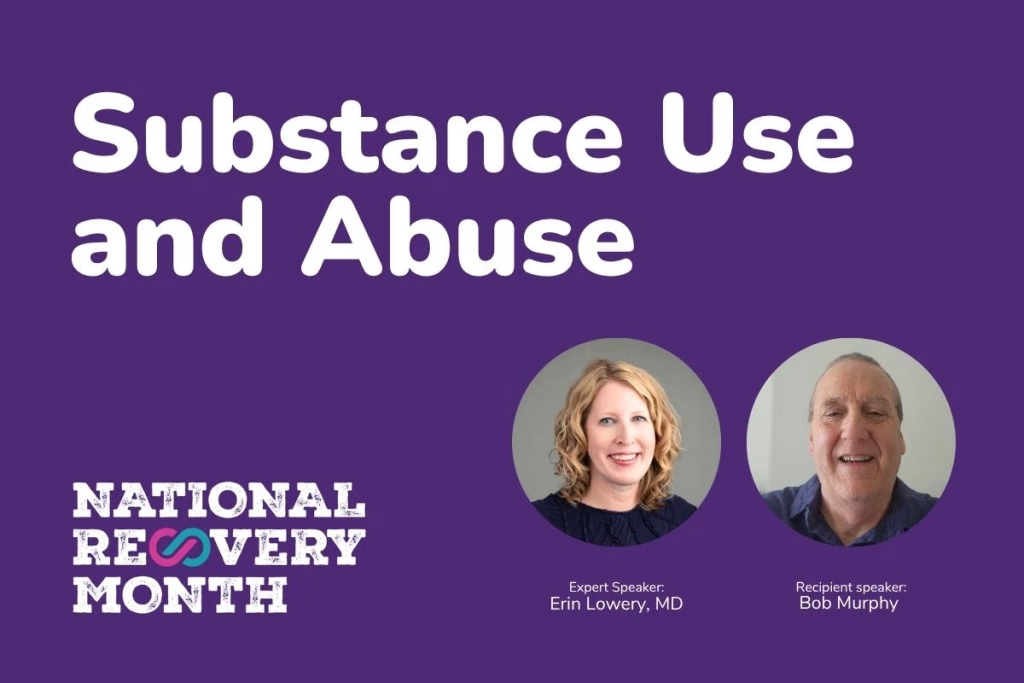
To learn more about the relationship between substance use and abuse, recovery, and lung transplantation, please join us for our next Transplant Talk on Thursday September 17 • 7 pm EST, where we will feature Dr. Erin Lowery, an expert in addiction and lung transplantation, and Bob who will be sharing his story live.
Are you a transplant candidate who has questions about your use of substances, and how that may impact your eligibility for listing? Do you have long term recovery, and feel nervous about how the additional stressors associated with lung transplant will impact your regular coping strategies? For all of those questions, and everything in between, we have invited Dr. Erin Lowery, the Medical Director for the Lung Transplant program at the University of Wisconsin, to teach us about this important topic. Together, we will cover the difference between substance use and substance abuse, the impact of substance use on recipients during their recovery from surgery (specifically the use of alcohol, nicotine, gummies, and benzos), and what type of help is available for lung transplant community members who are concerned about their use of substances. We will also hear from lung transplant recipient Bob Murphy, who will share his experience, strength, and hope with us.
Alongside the extraordinary circumstances of living with a lung transplant, recipients experience many of the same joys and struggles as …
The Lung Transplant Foundation Mentorship Program would like to recognize Tammy Robinson, one of our longest-serving Mentors. Tammy received a …

Receiving a lung transplant is a transformative, life-saving event. For individuals who faced late-stage lung disease, a successful transplant offers …

Creating a world where all lung transplant patients live long, healthy lives.
1249 Kildaire Farm Road, Suite 323
Cary, NC 27511
Disclaimer: This website does not provide medical advice. The information, including but not limited to text, graphics, images, and other material contained on this website are for informational purposes only. No material on this site is intended to be a substitute for professional medical advice, diagnosis, or treatment. Always seek the advice of your physician or other qualified health care provider with any questions you may have regarding a medical condition or treatment before undertaking any new health care regimen. Never disregard any professional medical advice or delay in seeking care because of something you have read on this website.